


Comfortable Everest Trek
13 DAYS
20 PEOPLE
2700 EURO


13 days
21.10.2026 - 3.11.2026
Immerse yourself in the charm of Kathmandu, the capital of Himalayan tourism and mountaineering. Sip the highest-altitude coffee in the capital of the Sherpas – the most enduring mountain people in the world. Walk the trails of Everest conquerors. Witness sunrises and sunsets over the planet’s highest mountains. Participate in a Buddhist service at a mountain monastery. Enjoy the unreal panoramas of the tallest peaks in the Himalayas. Climb Kala Patar, higher than Mount Elbrus. Take a selfie with the world’s highest mountain – the nearly nine-kilometer sacred Sagarmatha – Mount Everest – and experience its majesty. Land and take off from Lukla, one of the most extraordinary airports in the world.

Nepal is one of the world’s capitals of tourism and mountaineering. Our current expedition is probably the most popular adventure in the planet’s highest mountains. Trekking to Everest is included in the “50 must-do” – essential feats for every active person. It combines amazing fitness, rejuvenation of the body under the influence of harsh high-altitude conditions, and one of the most visually stunning journeys. Incredible mountain panoramas will accompany us throughout the expedition.
In addition, Kathmandu will give us experiences of the blending of two ancient religions, offering a glimpse into their mysteries and spiritual values.
Kathmandu is a charming, lively, noisy, and colorful city. Swayambhu, Boudhanath, and Pashupatinath – temples and sacred sites for countless people around the world. Namche Bazaar, the capital of the Sherpas – the most enduring mountaineers in the world, who made ascents above 8,000 meters possible. Thyangboche, the main monastery of Buddhist Sherpas. Kala Patar – a mountain 5,655 meters high, from which the best views of the world’s highest mountain, Everest (Sagarmatha in Sanskrit, Chomolungma in Tibetan), can be seen.

.jpg)
ROUTE
Kathmandu – Lukla – Monjo – Namche Bazaar – Pangboche – Dingboche – Lobuche – Gorak Shep – Kala Patthar – Lukla – Kathmandu

-
Double accommodation in 4* hotels in Kathmandu;
-
Porter services during the trek;
-
Services of local professional guides;
-
Accommodation in selected hotels during the trekking;
-
Cost of helicopter return to Lukla;
-
Airport meet and assistance by the expedition leader(s) from Paganel;
-
Meals – breakfasts in Kathmandu;
-
Excursions according to the program;
-
All transfers throughout the trip as per the itinerary;
-
Permits for visiting national park areas.
-
nternational flights to and from Kathmandu;
-
Flight to Lukla airport and back (as per program);
-
Meals during the trek;
-
Lunches and dinners in Kathmandu;
-
Tips;
-
All personal expenses;
-
Any other costs not mentioned in the program;
-
Entry tourist visa to Nepal;
-
Medical insurance.
Additional expenses:
-
Flight to Kathmandu and back.
-
Nepal visa: $30 (we recommend getting an online visa in advance).
-
Meals during the trek: approximately $300.
-
Lunches/dinners in Kathmandu: $10–30 per meal.
-
Tips: up to $100 per trip.
Type of trip: Trekking, exploration, experiencing authentic cultures…
Requirements: To participate in the expedition, you must be in good physical condition
A mandatory requirement is the absence of medical conditions that prevent long-term stays at high altitude.
Visa:
We strongly recommend obtaining your visa online in advance to avoid delays at the airport.
(To get a visa, you need to provide 1 photo and your passport at the border – the photo must be carried with you, not in your luggage.)
For entry to national parks, you will also need 2 additional photos.
Internal flight:
Luggage limit is 15 kg including hand luggage. Therefore, your packing must be high-quality, lightweight, carefully planned, and without unnecessary items. Of course, we have ways to work around some of the strict rules. Any minor excess baggage (if it occurs) can be paid for reasonably on-site. Details will be provided locally.
Weather:
October is the standard month for trekking in high season according to all guides in Nepal. Occasional light rain is possible. Kathmandu will be cool: +15–25°C, while the mountains at the highest altitudes on our trek will be cold – 0 to -6°C during the day. At night in Gorak Shep, temperatures can drop to -25°C. However, at this time we will stay in lodges with warm dining areas and plenty of blankets over your sleeping bag.
Acclimatization:
Most of the journey will take place at altitudes above 4000 m. Therefore, you should make sure there are no medical contraindications, prepare physically, and have a personal first-aid kit for common or chronic conditions. Altitude-related discomfort is possible, but we will do everything to minimize it.
Food:
Kathmandu has many excellent and inexpensive restaurants. On the trek, we will eat at small lodges along the route. Therefore, it is recommended to bring a camping spoon, knife, and a small lightweight thermos mug. In addition, we will advise participants on a set of personal food items to bring on the expedition. This will be discussed with the group before departure.
Important:
Since most of the costs for organizing the trip – flights, transport documents, accommodation, excursions, services of local companies and guides, etc. – are paid by us in advance, your prepayment or payment for the trip is non-refundable in case of cancellation. We simply cannot return it.
-
Clothing for temperatures down to -10°C, jacket with down or Primaloft filling (ski suit only as a last option);
-
Mountain or trekking boots;
-
Gaiters for snow and sand;
-
Sneakers;
-
Thermal base layers;
-
Fleece jacket;
-
Short-sleeve t-shirts – 2 pcs;
-
Trekking pants;
-
Lightweight membrane suit (jacket and pants – preferably with self-release zippers) with good waterproof/breathable membrane;
-
Thick wool or specialized trekking socks – 2 pairs;
-
Warm knit or polar hat;
-
Warm gloves plus windproof mittens;
-
Cap with visor and neck protection, or wide-brimmed hat and bandana/buff;
-
Backpack or, preferably, waterproof duffel (60–80 L) for the porter who will carry your main gear;
-
Assault/backpack 30–40 L for your personal items – for your comfort, choose a modern lightweight one;
-
Trekking poles (disposable poles can be purchased in Kathmandu);
-
Good sunglasses;
-
Sunscreen;
-
Sufficient underwear and socks;
-
Lightweight travel towel and personal hygiene items;
-
Sleeping bag with comfort temperature of -5°C, weight no more than 1.4 kg, compact size;
-
Camping spoon, thermos mug and/or thermos, knife;
-
Medications for any personal health conditions.
ATTENTION: Consult our guides before buying gear – they know exactly what you will need!
1. Our company operates as an international travel organizer, therefore groups are formed from travelers from Ukraine, the Baltic countries, the EU, Israel, North America, and other countries. The working languages of the trip are Ukrainian, Russian, and English, depending on the group composition and translation arrangements. Each guide speaks Ukrainian, and in personal communication we respond in the language of the inquiry. If a 100 percent Ukrainian-language trip is essential for you, please уточнюйте this before booking. The company does not cooperate with citizens of the Russian Federation and the Republic of Belarus.
2. Due to the fact that our expeditions do not include international flights to the starting point of the program, we cannot be held responsible for changes in flight conditions by airlines or airport requirements. Since our travelers fly from many different countries and cities, we never participate in the purchase of air travel and limit ourselves exclusively to advisory services in the selection of flights. Air agents or airlines from which tickets were purchased are responsible for the purchase and technical support.
ITINERARY
Day 1
21.10.2026
Arrival in Kathmandu, the colorful capital of Himalayan tourism and mountaineering. Transfer to the hotel and check-in. Walk through Thamel, the tourist center of this vibrant, cosmopolitan, chaotically charming city with its Indian-style bustle. Overnight in a cozy hotel.


Day 2
22.10.2026
A day in Kathmandu. Today’s excursions are a “gentleman’s set” for every Nepali traveler :), essentials for any program. We will climb the 365 steps of Swayambhu Stupa (the Monkey Temple), the oldest stupa in Nepal – the birthplace of Kathmandu and home to dozens of small monasteries.
We will visit one of the holiest sites for all Hindus, Nepal’s main ritual cremation site – Pashupatinath Temple, where according to legend lies the head (or mind) of Shiva. We will also explore “Little Tibet,” the area around the largest and most revered Buddhist stupa, Boudhanath.


In the evening, you can shop for any missing trekking gear. There is a huge selection to suit all tastes and budgets – you could even fully equip yourself arriving in shorts and flip-flops. Overnight at the same hotel. (Breakfast included)


Day 3
23.10.2026
Early breakfast at the hotel. Transfer to the airport and flight to the village of Lukla (2,827 m). Lukla Airport, named after Everest conquerors Tenzing Norgay and Edmund Hillary, is unique and an adventure in itself. The runway has a 12-degree incline, starts above a cliff, and ends at a mountain ridge.

This is the starting point for many mountaineering expeditions and treks, including our journey to the world’s highest mountain, Everest. The flight lasts about 45 minutes and offers breathtaking views of the Himalayan peaks. Meet the team of guides and Sherpas. After distributing luggage among the porters, we begin our trekking in the Himalayas. The hike to the village of Monjo (2,900 m) takes approximately 5 hours. Overnight in a guesthouse.

The guesthouse is not a tent camp, nor a mountain shelter, and yet not a full hotel – simple, clean, built in the style of local homes, with no in-room facilities. Blankets are provided, but it is recommended to sleep in thermal underwear and your own sleeping bag. Hot showers are available for an additional fee. Over the years, we have selected the most charming lodges and hosts. Meals are prepared on-site and served in cozy dining areas with wood stoves. It is recommended to bring a small set of personal food supplies from home, but we will discuss this later. (Breakfast included)

Day 4
24.10.2026
A 3–4 hour trek to the capital of “Sherpland” – Namche Bazaar (3,446 m), the famous hub for all Everest expeditions. Soon after leaving the lodge, we will cross the legendary Dudh Koshi River three times, which flows from the Khumbu Glacier. The third crossing – actually two bridges – is the famous Hillary Bridge, gifted to the Sherpas by the great New Zealander. Currently there are two bridges side by side – the older lower one is the original Hillary Bridge.

Ask your Paganely guides about the fascinating history of this mighty river and its bridges – they really have stories to tell, so don’t hesitate to ask! Along the way, we will see our first views of the snow giants, including the first glimpse of Chomolungma (Everest). Visit the small Buddhist monastery, Namche Gompa. We will arrive fairly early, around 11 a.m., and spend the rest of the day acclimatizing. The lively village has plenty of cafes and shops selling souvenirs, food, tourist clothing, and gear. Here you can enjoy a cappuccino, a pastry, or even a real pizza – a special treat in the mountains. Overnight in a guesthouse.


Day 5
25.10.2026
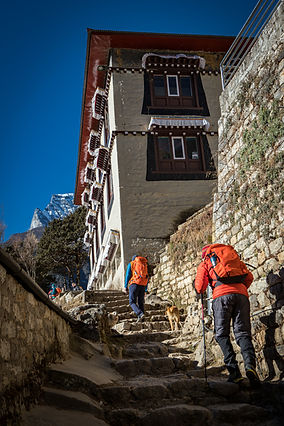
Trek to Kyangjuma (3,620 m), which takes about 3 hours and offers our first truly breathtaking views of Ama Dablam (6,814 m) – one of the most beautiful mountains on our planet. The café terrace in front of our lodge is located directly opposite the giant peak, whose view is mesmerizing, making you forget food and drink; morning coffee here could feel like it costs a lifetime.
After lunch and rest, we can do a two-hour acclimatization walk to the nearby village of Khumjung (3,800 m), whose monastery is said to house the scalp of the legendary Himalayan Yeti. Overnight in a guesthouse.

Day 6
26.10.2026
After the promised morning coffee alone with Ama Dablam, trek to Thyangboche (3,867 m, about 3 hours). From Thyangboche, there is a magnificent panorama of the mountain peaks – Ama Dablam, Lhotse, Everest itself, and many others.


The remarkable monastery in the village is known far beyond the region. After visiting the monastery and having lunch, a short trek brings us to Dingboche (3,800 m, about 20 minutes). Dingboche is known as the highest “green zone” for climbers – the last cozy forest before the alpine tundra, where mountaineers rest between high-altitude climbs. Total trekking time today is about 4 hours. Another beautiful mountain sunset accompanies our dinner. Overnight in a guesthouse.


Day 7
27.10.2026
Acclimatization day in Thyangboche. Visit the monastery, famous for its main festival, Mani Rimdu, when monks wearing bright masks perform mystical dances and rituals. Above the monastery and the rocky outcrop it sits on rise the fantastic peaks of Everest, Lhotse, and Ama Dablam.


Day 8
28.10.2026
Trek to Dingboche (4,410 m), about 4.5 hours. From Dingboche, there is a fantastic view of the Himalayas. The mighty technical 6,000-meter peaks – Thamserku and Kangtega – are visible in all their glory. Above it all still towers the winged peak of Ama Dablam.

Acclimatization hike towards the village of Chhukung. While Dingboche is a cozy, wind-protected settlement built specifically for tourists and climbers, Chhukung is the highest permanently inhabited village of mountain herders. As you can imagine, nothing edible for humans grows at 5,000 m, but the yaks, the highland natives, successfully find sustenance. Overnight in a guesthouse.


Day 9
29.10.2026
Trek to Lobuche (4,910 m), starting with a long hour-long ascent, taking about 2.5 hours in total. The small village of Lobuche – a transfer base for climbers, tourists, and Tibetan traders – is located near the Khumbu Glacier, descending from Everest, at the foot of the eponymous Lobuche Peak and the nearly 8,000-meter sharp giant Nuptse, which from here appears even taller than Everest.

In clear weather, usual for this season, Nuptse’s summit provides an evening sunset display like no other. Overnight in a guesthouse.

Day 10
30.10.2026
Trek to Gorak Shep (about 3–4 hours). This is the last permanent settlement on the way to the Everest Base Camp, located at 5,136 m above sea level. Beyond this is only the EBC itself – a tented camp at 5,360 m, set up for a short few months in April–May and September during the Everest climbing seasons.

Ascent to Kala Patar (5,545 m). The climb takes about 2 hours, timed to reach the evening crimson light over the world’s highest mountain region. Before noon, the sun illuminates Everest from the side, which can be distracting for both eyes and camera lenses; by evening, the panorama is clear and contrasting, in perfect side lighting. From here, magnificent views open up of the world’s highest peak – Everest (Chomolungma – Sagarmatha, 8,848 m), Lhotse (8,501 m), Nuptse (7,861 m), Pumori (7,161 m), the Khumbu Glacier, and the surrounding mountain grandeur!
Return to Gorak Shep takes about 40 minutes. For most, this will be the highest overnight of their lives! Overnight in a guesthouse.


Day 11
01.11.2026
Our return begins from the realm of glaciers back to the world of life. By helicopter, we return to Lukla. This is a completely separate adventure – flying between ice giants and admiring their beauty from a completely different perspective, as if looking them in the eye.


Next, we take a scheduled flight back to Kathmandu, followed by a transfer to the hotel. The rest of the day is free in Kathmandu. You will be surprised at how familiar and welcoming this city feels, which at first seemed chaotic. The food will taste incredible, and the air will feel rich and dense!

Day 12
02.11.2026
ou can never get enough of Kathmandu. A free day in the Nepalese capital is pure enjoyment – delicious food, colorful shopping. Here, you can dress children and adults in trekking gear from head to toe, for every taste and budget. Empty your pockets and fill your duffels, purchased locally, with countless charming but unnecessary items that will delight your family and friends. (Breakfast included)


Day 13
03.11.2026
Farewell to the Himalayas. Transfer to the airport for your flight home according to your purchased tickets. (Breakfast included)

WHY WITH PAGANEL?
We are unique
For many years, we have been traveling the world to our small planet's most remote and unusual places. We do not use the services of domestic travel agencies. The trips we invent and carry out are always unique and have their unique zest, charm, and adventurous spirit.

Creation
The first thing that interests us is creativity in everything. During the expeditions, we shoot a lot of videos, take pictures, write stories, draw pictures. If you are interested in a creative approach to life and travel, then WELCOME... we are very happy to meet you!

Interest
By joining our team, you join a kind of club family, which already consists of several hundred people who are interested in discovering the world with us.
Since most of the expenses for organizing a trip – air tickets and travel documents for other modes of transportation, accommodation, excursions, services of local companies and guides, etc. – are made by us in advance, long before the trip, the prepayment or payment for the trip is non-refundable in the event of cancellation.

Since most of the expenses for the organization of the trip are air tickets and travel documents for other types of transport, accommodation, excursions, services of local companies and guides, etc. are not refundable in case of your cancellation of the trip. We simply have no way to return it.
Please note that this itinerary is tentative. The weather always has the last word. The itinerary is designed to allow sufficient time at the end of the Expedition in case of any weather-related delays. If necessary, the captain can change the expedition route depending on external conditions!
.png)